
What Changes When Researchers Write for the Reader
The Reader Expectation Approach does not ask researchers to simplify their science. It asks them to place their meaning where readers instinctively look for it — so that reviewers, editors, and decision-makers grasp complex work on the first reading rather than the third. The result is prose that costs the reader less effort and earns the writer more.
The evidence for that result takes three forms: peer-reviewed outcomes from a faculty training program, the caliber of institutions that have made REA part of their research culture, and the accounts of researchers who have used it in their own work.
Peer-Reviewed Outcomes: Indiana University School of Medicine
Learn about REA training options→

“Scientific Writing From the Reader’s Perspective, taught by Professor George Gopen, is the single most highly rated faculty development program offered at Indiana University. One senior colleague with over 100 publications to his credit attended Dr. Gopen’s workshop and summed up his experience by stating ‘This was the best investment I ever made — the most cost effective time I have ever spent.’ That sentiment accurately reflects the yearly evaluations of this extraordinary learning experience.”
— Stephen P. Bogdewic, PhD, MA
Executive Vice Dean Emeritus at Indiana University
and Senior Associate Dean for Faculty Affairs and Leadership Development at University of North Carolina

Indiana University
The most direct measure of what REA training accomplishes comes from a faculty development program at the Indiana University School of Medicine, published in the Journal of Faculty Development (Dankoski et al., 2012), with George David Gopen among the authors.
Of the faculty surveyed after the program, 87% reported greater confidence in communicating their ideas in writing, 72% believed their manuscripts and grant proposals would be more competitive, and roughly one-third reported increasing their grant submissions in its wake. These are the participants’ own assessments of their work — the honest measure of what a writing program can change: how researchers write, how they judge their writing, and how willing they are to put it forward.
The Institutions That Invest in REA
For more than three decades, some of the most research-intensive universities in the United States have brought the Reader Expectation Approach to their faculty and trainees — among them Duke University, Johns Hopkins University, the University of North Carolina, the University of Pittsburgh, the University of Colorado, and Indiana University.
These are institutions responsible for a substantial share of the nation’s federally funded research. Their scientists compete for the most demanding grants in the country, and they have chosen to invest, repeatedly and over decades, in teaching their researchers to write for the reader. The company REA keeps is itself a measure of its standing among people whose work depends on being understood.
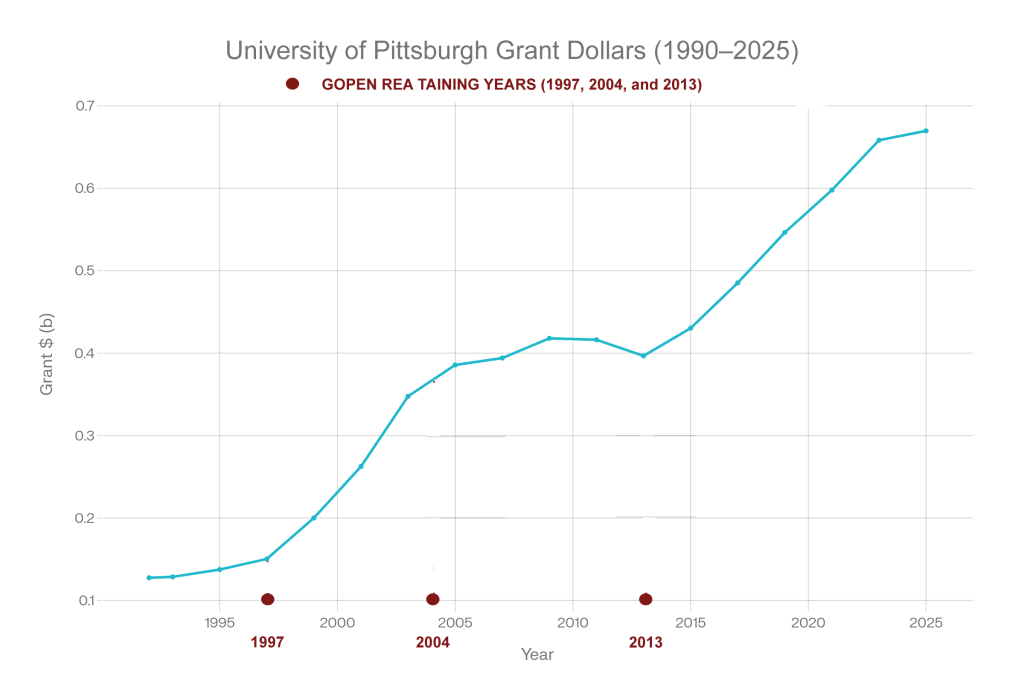
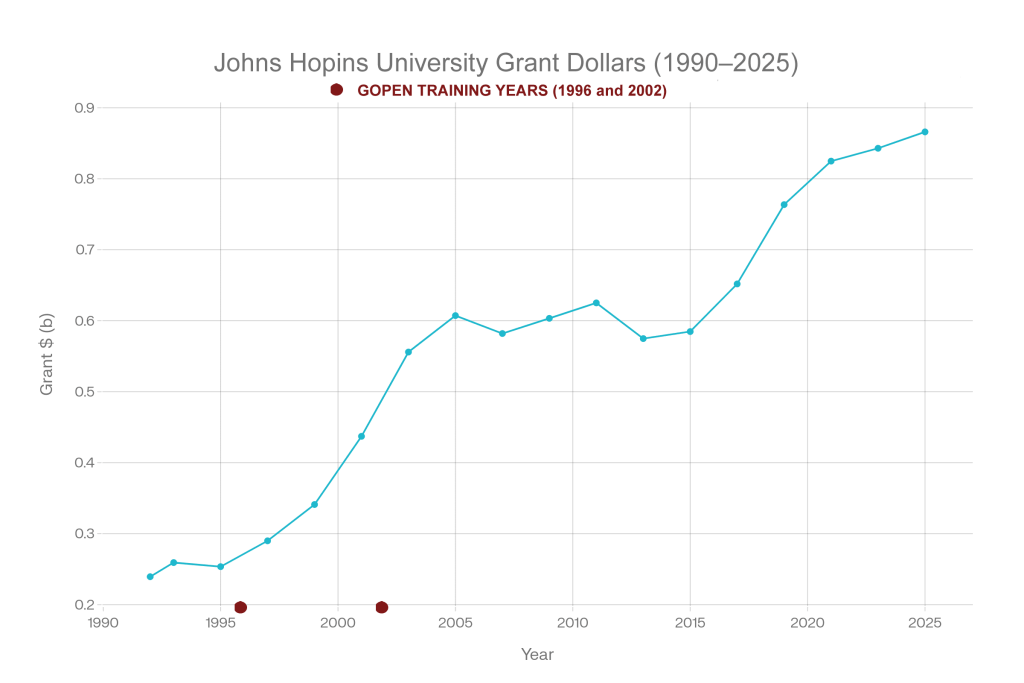
(Data compiled by Dr. Barbara Croft from NIH Online Reporting Tools RePORT (02/16/2026.)
Duke University
Duke University implemented George Gopen’s Reader Expectation Approach training continuously from 1992 through 2020. A 2011 study in CBE–Life Sciences Education found that teaching George Gopen’s Reader Expectation Approach produced measurable improvements in research writing.


University of North Carolina
The University of North Carolina adopted George Gopen’s training in the Reader Expectation Approach as an ongoing program from 2004 through 2020.
University of Pittsburgh
At the University of Pittsburgh, George Gopen’s trainings in 1997, 2004.

University of Colorado
George Gopen’s Reader Expectation Approach was introduced at the University of Colorado in 2013 and 2014.
Johns Hopkins University
At Johns Hopkins University, George Gopen trained both in 1996 and 2002.
In Their Own Words

“The empirical test, which I demand as a scientist, is that I would show it to people before and after — they were able to follow it much more clearly when I used the Gopen method.” — Cliff Cunningham, PhD, Professor of Biology, Duke University
“Your article on the science of scientific writing was a total godsend to me and formed the basis of the curriculum I created for the University Writing Program at the University of Florida.” — Yellowlees Douglas, PhD, author of Writing for the Reader’s Brain (Cambridge University Press, 2025)


“Dr. Gopen’s Reader Expectation Approach has reshaped scientific writing, offering insights into crafting persuasive and reader-centered content.” — Virginia Byers Kraus, MD, PhD, Mary Bernheim Distinguished Professor of Medicine, Duke University School of Medicine
Grant funding is more competitive than ever.
When reviewers must work to follow an argument, the writing — not the science — becomes the obstacle. The Reader Expectation Approach removes that obstacle, giving strong research its best chance to be understood, judged on its merits, and funded. Request a discovery call today to discuss reader expectation training for your institution.