PRESS INQUIRIES
Robyn Wagoner
press@georgegopen.com
(212) 202-5619
New York, USA
- Client Roster/Full CV→
- Bio (short)→
- Head Shots→
- Reader Expectation Approach (description)→
- Reader Expectation Approach in Peer-reviewed Literature→
- Bio (long)→
- New Books→
- Bibliography→
- Media Appearances→
- Videos→
- Image Gallery→
Bio (short)
George David Gopen, JD, PhD, is Professor Emeritus of the Practice of Rhetoric at Duke University. He is widely recognized as the creator of the Reader Expectation Approach (REA) to Writing in the English Language. Virginia Kraus, the Mary Bernheim Distinguished Professor of Medicine at Duke University, has credited REA with reshaping scientific writing.
Dr. Gopen has published six books and 80 articles. He introduced his REA framework through his influential 1990 article, “The Science of Scientific Writing,” co-authored with Judith A. Swan and published in American Scientist. The article has been independently reprinted and taught at universities worldwide for 35 years. His expanded and updated book version, The New Science of Scientific Writing, is available in English and will be followed by 17 additional languages within the year.
REA has been evaluated in peer-reviewed literature and applied across disciplines. In 2011, Dr. Gopen received a lifetime achievement award from the Legal Writing Institute, for his contributions to the profession. His client roster of over 200 organizations — including NIH, CDC, Johns Hopkins, Harvard Law School, Pfizer, and the American Bar Association — represents tens of thousands of professionals worldwide.
Head Shots by Paul D’Andrea


Gopen Author Cover (wide)
File format: PNG
1080 by 694 pixels
Resolution: 300 dpi
File size: 805 KB
Gopen Author Cover (wide)
File Format: JPEG
1080 by 721 pixels
Resolution: 72 dpi
File size: 77 KB
Gopen Author Cover (square)
File format: JPEG
694 x 694 pixels
Resolution: 72 dpi
File size: 63 KB


REA Promo (wide)
File format: PNG
1080 by 721 pixels
Resolution: 300 dpi
File size: 1.1 MB
REA Promo (wide)
File format: JPEG
1080 by 721 pixels
Resolution: 72 dpi
File size: 57 KB
REA Promo (square)
File format: JPEG
714 x 714 pixels
Resolution: 72 dpi
File size: 57 KB
Reader Expectation Approach (description)
The Reader Expectation Approach (REA) is a framework for professional writing from the reader’s perspective. Consistent with cognitive psychology and psycholinguistics, REA is based on the insight that readers of English look for critical information in specific structural locations within sentences and paragraphs. When writers repeatedly violate readers’ expectations, readers must expend energy to resolve the structural confusion, interfering with their comprehension of the material. A reader must answer four questions if they are to understand what a writer is saying: Who’s story is it? What is happening? What information deserves more emphasis than the rest? How does the sentence I’m reading now link backward and forward to its neighbors? If any one of these is misunderstood, the reader will fail to receive the message the writer is attempting to convey. REA involves practices such as subject-verb proximity, utilizing stress positions, and sentence connectivity, among others.
REA has been evaluated in peer-reviewed literature and applied in the creation of tools and curricula across legal, medical and scientific disciplines. Actor and science communicator Alan Alda discusses REA as a model for science communication in his 2017 book If I Understood You, Would I Have This Look on My Face?
Reader Expectation Approach in Peer-reviewed Literature
Medicine & Life Sciences
- Lingard, L. Perspectives on Medical Education, 2022 — applies REA principles to scholarly medical writing.
- Kraus, V.B. Transactions of the American Clinical and Climatological Association, 2025 — draws parallels between REA and compositional principles in scientific writing. Credits George for “reshaping scientific writing” with REA.
- Reynolds & Thompson. CBE–Life Sciences Education, 2011 — cites Gopen & Swan within a peer-review–based writing intervention.
- Dankoski et al. Journal of Faculty Development, 2012 — peer-reviewed study of REA-based faculty writing program at Indiana University School of Medicine.
- Regan & Pietrobon. Journal of Nursing Education, 2010 — REA applied as a framework for scientific writing in nursing education.
Education
- Shultz & Gere. Journal of Chemical Education, 2015 — identified “the lack of attention given to reader-expectation principles in most contemporary scientific writing” as a barrier to clear scientific communication — citing Gopen’s foundational research on the subject.
- Phatak & Hudgins. Chemical Engineering Education, 1993 — among the earliest independent citations of REA in engineering education.
- Ottewell, K. In The Future of Doctoral Research (Routledge, 2021) — applies REA to challenges facing second-language academic writers.
Law & Legislative Drafting
- Hunt, B. Statute Law Review (Oxford University Press), 2002 — positions REA within the plain language tradition of legislative drafting .
- Riebe, D.D. Gonzaga Law Review, 2005 — applies reader expectation theory to legal writing.
Environmental Sciences
- Schmolke et al. Trends in Ecology and Evolution, 2010 — cites REA principles in guidance on writing ecological models for policy audiences.
Computer Science & NLP
- Samaraweera et al. IEEE ICPC, 2011 — proposes applying REA to source code readability.
- Kinnunen et al. EACL, 2012 — built SWAN, an automated writing assistant grounded in REA principles.
Scholarly Commentary
- Mick, D.G. Design Research Quarterly, 2008 — past president of the Association for Consumer Research calls Gopen & Swan “one of the best discussions of reader expectations in academic prose.”
- Lebrun, J-L. Scientific Writing: A Reader and Writer’s Guide (World Scientific, 2007) — engages REA as a substantive theoretical framework.
- Alda, A. If I Understood You, Would I Have This Look on My Face? (Random House, 2017, pp. 134–136) — discusses REA for a general audience.
Bio (long)
George David Gopen, JD, PhD, is Professor Emeritus of the Practice of Rhetoric at Duke University. He is widely recognized as the creator of the Reader Expectation Approach (REA) to Writing in the English Language. He developed REA through his own observations as an educator, writing consultant, and classical musician. He also credits his visual impairment as a formative influence.
Dr. Gopen was born September 26, 1945 in Cambridge, Massachusetts. From 1957 to 1963 he attended the Roxbury Latin School, founded in 1645. He received a Bachelor of Arts in English from Brandeis University where he graduated Phi Beta Kappa in 1967. His undergraduate education included a year at the University of Reading in England. He simultaneously earned his Juris Doctor (JD) from Harvard Law School and his PhD in English from Harvard Graduate School of Arts and Sciences from 1967 to 1975.
Dr. Gopen taught at Duke University for 30 years in the English Department, part-time at the Law School (16 years). From 1980 to 1990, Dr. Gopen partnered with Joseph Williams and Gregory Colomb of University of Chicago to build a writing consultancy called Clearlines.
In 1990 his influential article “The Science of Scientific Writing” was co-authored with Judith A. Swan and published by American Scientist. Virginia Kraus, the Mary Bernheim Distinguished Professor of Medicine at Duke University, has credited the article with reshaping scientific writing.
Since 1990, Dr. Gopen has been working independently as a professional writing consultant with leading organizations including NIH, CDC, Johns Hopkins, Harvard Law School, Pfizer, and the American Bar Association. His client roster of 225 organizations represents tens of thousands of professional writers around the world.
Nobel Laureate Seamus Heaney credited George D. Gopen by name in the acknowledgments of his translation of Robert Henryson’s The Testament of Cresseid and Seven Fables (2009), writing that Gopen’s prose translation helped him persist through the work at a moment he might otherwise have abandoned it.
“I am grateful to [poet] Dennis O’Driscoll for providing me with George D. Gopen’s helpful prose translation of Robert Henryson’s Moral Fables at a moment when I might have been inclined to give up on the job.”
— Seamus Heaney, Nobel Laureate
In 2011, Dr. Gopen received a “Golden Pen” lifetime achievement award from the Legal Writing Institute for his lifelong efforts to improve legal writing.
Dr. Gopen has published six books and 80 articles. Forty-two of these articles were published in the American Bar Association’s Litigation journal. In 2026, Dr. Gopen signed contracts with Anthem Press in London for six more books. The first of that series being The New Science of Scientific Writing . A revision and expansion of Gopen’s highly acclaimed and widely influential 1990 American Scientist article, this book reveals the expectations held by all readers of English — allowing control of both the writing process and the reader’s interpretive process. The book was released in English on September 15, 2026, to be followed by translations in 17 additional languages within the year.
Dr. Gopen is also a championship golfer, rare book collector, and founder, MC, and judge of the Great Durham Pun Championship.
New Books

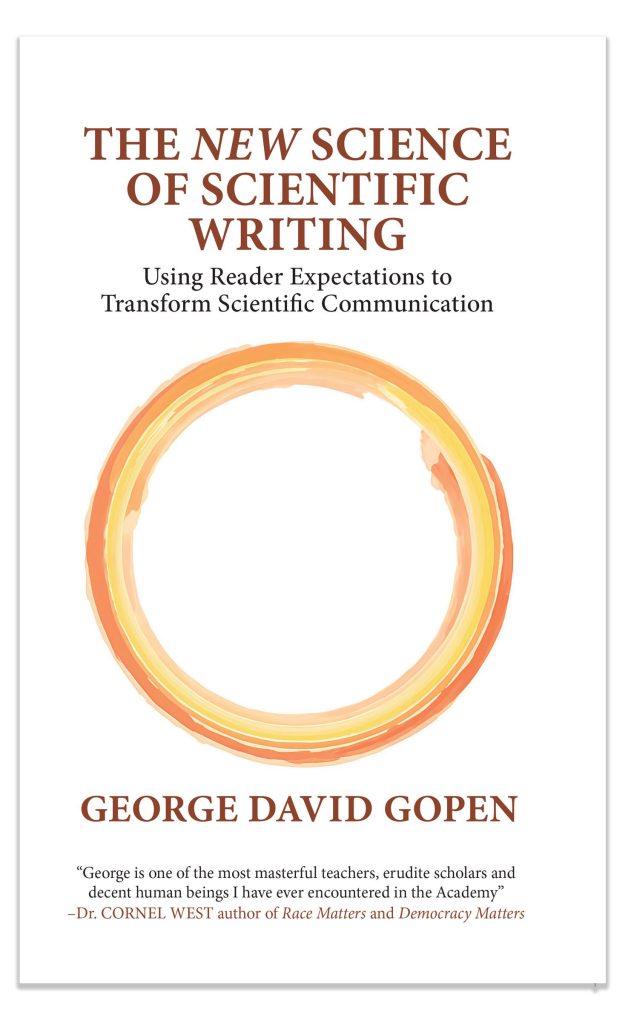
RELEASED ON SEPTEMBER 15, 2026
The New Science of Scientific Writing: Using Reader Expectations to Transform Scientific Communication is an update and expansion of Gopen’s acclaimed 1990 American Scientist article credited with reshaping scientific writing.
For more than three decades, George David Gopen’s Reader Expectation Approach has transformed how scientists, researchers, and professionals write — not by prescribing rules, but by revealing how readers read. The structural framework for writing clearly and persuasively in the English language was first introduced in George’s landmark article “The Science of Scientific Writing,” co-authored with Judith A. Swan and published in American Scientist.
“Dr. Gopen’s article is our #2 most viewed online article overall, for the entire period since 2017, with almost 148,000 views. It is certainly fair to say that it is one of our most popular, read, cited, and requested articles.”
— Fenella Saunders, Editor-in-Chief, American Scientist
The New Science of Scientific Writing expands and deepens George’s foundational work, drawing on decades of seminar teaching across research universities, national laboratories, medical schools, and law firms worldwide.
Within the year, this book will have appeared in 18 languages: English, Italian, French, German, Spanish, Mandarin traditional, Mandarin simplified, Hindi, Urdu, Japanese, Korean, Russian, Ukrainian, Hausa, Arabic, Hebrew, Portuguese, and Swedish.
Download Book Cover Image (PNG file 1080 x 694 at 300 dpi)
MORE FORTHCOMING BOOKS:
Mark My Words: Punctuation Explained from the Reader’s Perspective is a book that examines punctuation from the perspective of the reader rather than society.
RELEASE DATE: TBA 2026
The Shape of English: Understanding the Expectations of Readers is the sum of all that Dr. Gopen has learned of the written language since he began his investigations in 1978. At least two (2) translations are planned.
RELEASE DATE: TBA 2026
Legal Writing & Readers
RELEASE DATE: TBA
Writing Transformed: Understanding the English Language from the Reader’s Perspective
RELEASE DATE: TBA 2026
Mr. Lincoln’s Music: How Elegance Leads to Eloquence is an exploration of a new, musical method of writing to go beyond clarity and power to achieving elegance.
RELEASE DATE: SUMMER 2027
Bibliography
The Moral Fables of Aesop (translated from 15th-century Middle Scots, with introduction and notes; University of Notre Dame Press, 1987) ISBN 978-0268013615 (hardcover), ISBN 978-0268013622 (paperback)
The Sense of Structure: Writing from the Reader’s Perspective (Pearson Longman, 2004) ISBN 978–0205296323
Expectations: Teaching Writing from the Reader’s Perspective (Pearson Longman, 2004) ISBN 978–0205296170
Gopen’s Reader Expectation Approach to the English Language: A New Tweetment (THINKaha, 2016) ISBN 978–1616991746
The New Science of Scientific Writing (Anthem Press, September 15, 2026) ISBN: 9781801360937
Book Chapters
“The State of Legal Writing: Res Ipsa Loquitur” in Writing in the Business Professions, ed. Myra Kogen (National Council of Teachers of English, 1989) pp. 146–173 ISBN 0-8141-5900-1
“How to Improve Your Advisees’ Writing Permanently — in 30 Minutes” in Developing Research Writing: A Handbook for Supervisors and Advisors, ed. Susan Carter and Deborah Laurs (Routledge, 2018) p. 77 ISBN 978-1138688155
Audiobooks
Peter Sterling, What is Health? Allostasis and the Evolution of Human Design (narrator; Author’s Republic, 2023; print edition MIT Press, 2020)


Media Appearances
George is currently available for workshops, keynotes, expert witness engagements, and media interviews. Contact Robyn Wagoner at press@georgegopen.com.
Audio


Listen: “Pundemonium: The Great Durham Pun Contest.” George is interviewed about how the contest works and what makes puns great (WUNC, February 2018)→


Videos
WATCH: REA Introduction
WATCH: Clients Tell Their Stories

Watch: George reads T.S. Eliot’s The Waste Land→
George also offers a line-by line close textual analysis of the classic modernist poem.

