Using Reader Expectations to
Transform Scientific Communication
by George David Gopen
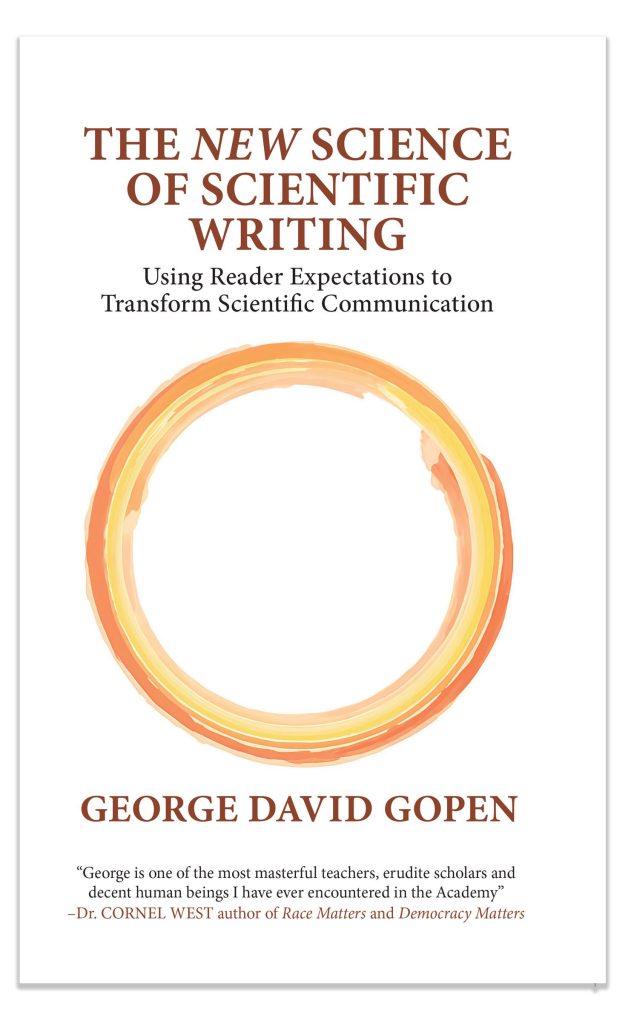
For more than three decades, George David Gopen’s Reader Expectation Approach has transformed how scientists, researchers, and professionals write — not by prescribing rules, but by revealing how readers read. The structural framework for writing clearly and persuasively in the English language was first introduced in George’s landmark article “The Science of Scientific Writing,” co-authored with Judith A. Swan and published in American Scientist.
The New Science of Scientific Writing: Using Reader Expectations to Transform Scientific Communication is an update and expansion of George’s acclaimed 1990 article, which has been credited with reshaping scientific writing.
“Dr. Gopen’s article is our #2 most viewed online article overall, for the entire period since 2017, with almost 148,000 views. It is certainly fair to say that it is one of our most popular, read, cited, and requested articles.”
— Fenella Saunders, Editor-in-Chief, American Scientist
The New Science of Scientific Writing expands and deepens George’s foundational work, drawing on decades of seminar teaching across research universities, national laboratories, medical schools, and law firms worldwide.
Within the year, this book will have appeared translated into 17 languages: Italian, French, German, Spanish, Mandarin traditional, Mandarin simplified, Hindi, Urdu, Japanese, Korean, Russian, Ukrainian, Hausa, Arabic, Hebrew, Portuguese, and Swedish.
Download Book Cover Image (PNG file 1080 x 694 at 300 dpi)

Where other writing guides offer style rules and structural templates, Gopen offers something more fundamental: A cognitive account of how meaning is made. REA was developed independently through observation and practice and has been corroborated by findings in cognitive linguistics, psycholinguistics, and discourse analysis.
The Reader Expectation Approach rests on a deceptively simple insight: readers of English have deeply ingrained expectations about where in a sentence or paragraph they will find certain kinds of information. When writers fulfill those expectations readers understand. When writers violate them, even the most accurate science becomes difficult to follow, not because the ideas are complex, but because the prose is working against the reader’s natural interpretive process.
This book arrives at a critical moment for global science communication. With millions of non-native English speakers required to publish in English-language journals, and with research funding increasingly contingent on the clarity of grant proposals, the need for a principled, reader-centered writing framework has never been greater. For scientists whose careers depend on being understood — and whose funding depends on making reviewers believe — this book offers what no style guide can: a principled account of how readers make meaning, and a practical method for working with that process rather than against it.
ISBN-13: 978-1-80136-093-7
ISBN-10: 1-80136-093-6
Library of Congress: 2026939299
Format: Paperback | September 2026